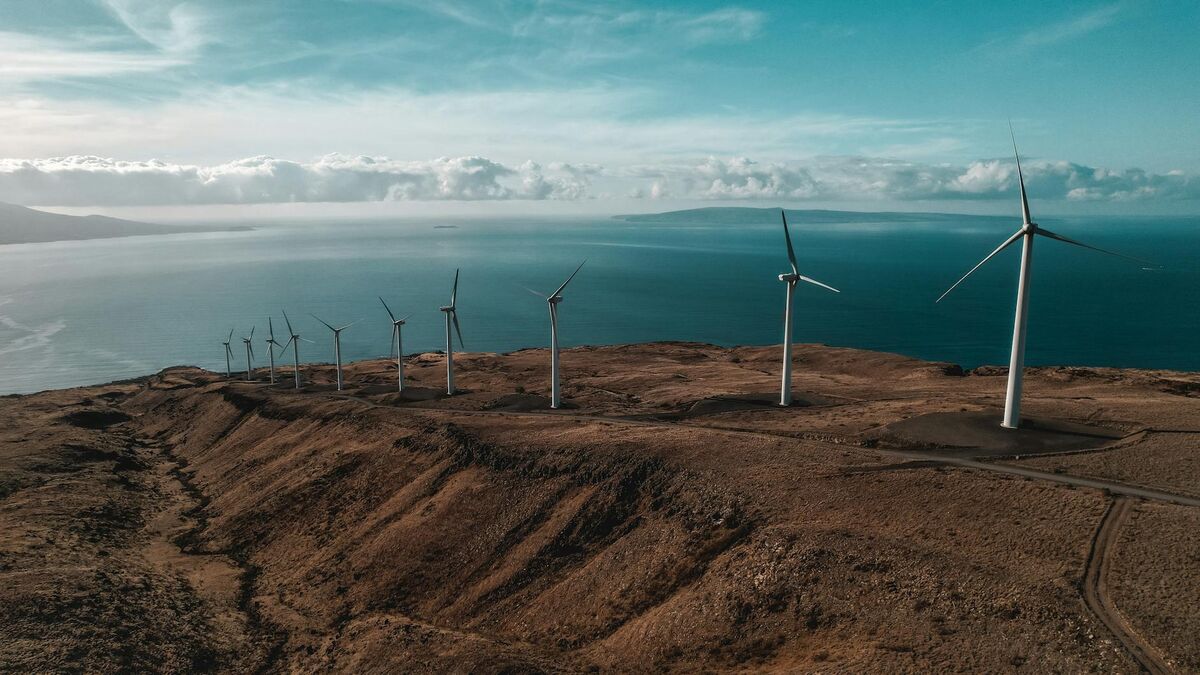
A wind turbine drone inspection uses a drone to photograph and video every surface of a turbine's blades, tower and nacelle from the air, replacing most rope access climbs and ground telescope checks. The drone flies close passes along each blade while the rotor is stopped, records leading edge erosion, cracks and lightning damage, and lands with a full visual record in well under an hour. This guide covers what drone inspections of wind turbines find, how a flight works step by step, how drones compare with rope access on time and cost, which drones crews use, and how turning the inspection video into a measurable 3D model improves reports and repair planning.
Key Takeaways
- A wind turbine drone inspection captures all four sides of each blade (leading edge, trailing edge, pressure side, suction side) plus the tower and nacelle in one short stop.
- The main findings are leading edge erosion, cracks, delamination, lightning damage, trailing edge splits and tower corrosion; drones find surface damage, while internal structural checks still need internal or contact methods.
- Published industry estimates put drone inspections at roughly a fifth to a quarter of the cost of manual rope access per turbine, with far shorter downtime.
- Videogrammetry turns the same inspection video into a measurable 3D model; SkyeBrowse delivers 0.5 inch accuracy on Commercial and Pro and 0.1 inch on Public Safety & Enterprise, and accuracy rises as you fly closer.
- A 3D model with image walkthroughs lets engineers, repair contractors and OEMs review every defect in context from a browser, without another site visit.
Contents
- What is a wind turbine drone inspection?
- What do drone inspections of wind turbines find?
- How does a wind turbine drone inspection work?
- How do drones compare with rope access and ground inspections?
- What makes a good wind turbine inspection drone?
- How much does a wind turbine drone inspection cost?
- How does a 3D model improve wind turbine inspection reports?
- FAQ
What is a wind turbine drone inspection?
A wind turbine drone inspection is a visual condition survey of a turbine's blades, tower and nacelle flown by a drone instead of rope access technicians. The turbine is stopped, the drone captures high-resolution imagery or video of every blade surface, and engineers review the results to grade damage and plan repairs.
Blades are the main target. They are long composite structures, and the leading edge takes constant impact from rain, dust and insects at high tip speeds. The US Department of Energy explains how blade aerodynamics drive the rotor, which is why even modest surface damage costs energy production. Operators inspect to catch erosion and cracks while they are cheap to repair, document condition before warranty periods end, and confirm damage after lightning strikes or storms.
Drone inspection of wind turbines falls into two groups. External inspections fly around the turbine to record the outside of the blades, tower and nacelle. Internal inspections send a small caged drone or crawler inside the blade or tower to check bond lines, webs and structure. This guide focuses on external inspections, which are the bulk of fleet work.
What do drone inspections of wind turbines find?
Drone inspections of wind turbines find leading edge erosion, surface cracks, delamination, lightning strike damage and receptor wear, trailing edge splits, missing or damaged vortex generators, tower coating failures and corrosion, oil leaks around the nacelle, and debris or damage on the platform. Each finding is logged with its blade, side and distance from the root.
The damage that matters most varies by site and blade age:
- Leading edge erosion starts as pitting and grows into exposed laminate. It reduces aerodynamic efficiency and is the most common repair item on older fleets.
- Cracks and delamination in the shell or along bond lines can grow under cyclic loading and are the findings engineers watch closely between inspections.
- Lightning damage shows up as burn marks, punctures or missing tip sections, and lightning protection receptors wear over time.
- Trailing edge splits open along the thin rear edge of the blade.
- Add-on damage includes missing vortex generators, loose leading edge protection tape and damaged serrations.
- Tower and nacelle issues include coating failure, corrosion, bolt and flange problems visible from outside, and oil streaks that point to a leak.
Surface findings are what drones see. Defects inside the laminate need internal inspection or contact methods, so many operators pair an annual external drone campaign with targeted internal checks on blades that show warning signs.
How does a wind turbine drone inspection work?
A wind turbine drone inspection follows six steps: plan the flight and permissions, stop and lock the turbine with blades in a set position, fly close passes along all four sides of each blade, capture the tower and nacelle, upload the video, then review and grade findings. Most crews finish one turbine in under an hour.
- Plan. Confirm Part 107 or other FAA authority, check airspace near the site, and coordinate the stop schedule with the operations center. The FAA's drone program pages cover pilot certification and airspace authorization.
- Stop and position. Operations stops and locks the rotor and yaws the nacelle so the wind is favorable for the flight. Many crews set one blade pointing straight down so the other two form a "Y" or "rabbit ears" shape.
- Fly each blade. Fly slow, close passes from root to tip along the leading edge, trailing edge, pressure side and suction side of each blade. Keep the distance steady; image detail depends on it.
- Capture the rest. Fly an orbit of the nacelle and hub, then a vertical pass down the tower. Add a site pass of the pad, crane area and access road if civil works are part of the scope.
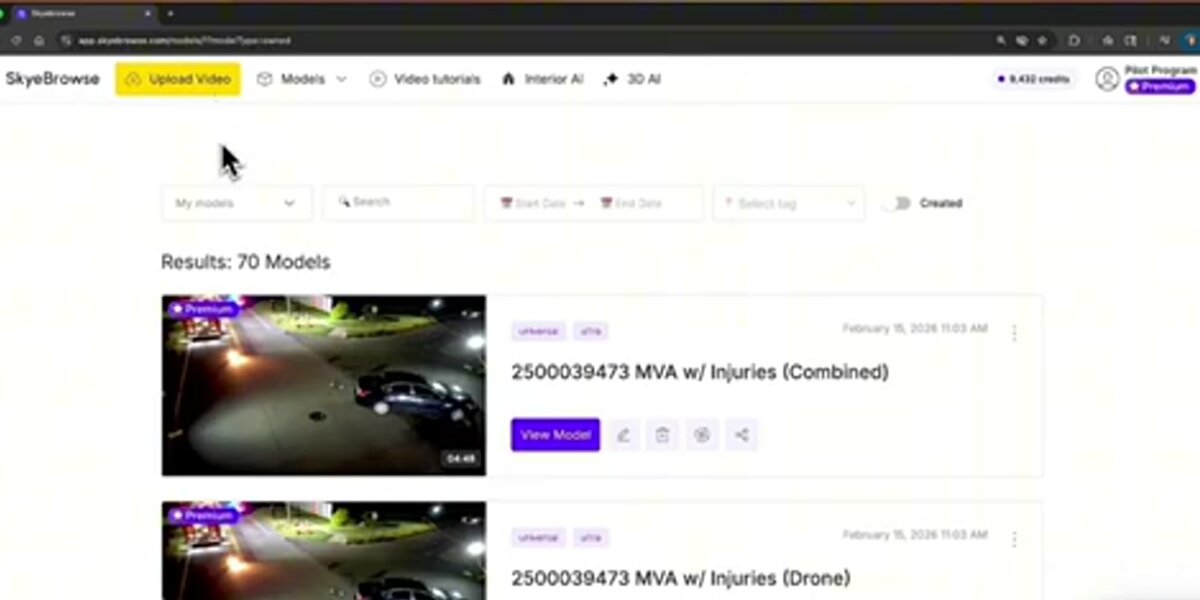
- Upload. Upload the video through SkyeBrowse Universal Upload at app.skyebrowse.com with the drone's .SRT (DJI) or .ASS (Autel) telemetry. Commercial and Pro models accept up to 3 videos per model and Public Safety & Enterprise up to 10, so blade passes and the tower orbit can feed one turbine model.
- Review and report. Grade each finding by severity, tag it to blade, side and radius, and export the report and model.
Planning tip: fly the same sequence and standoff distance every year. Consistent capture is what makes year-over-year comparison reliable.
How do drones compare with rope access and ground inspections?
Drones inspect a turbine faster and with less downtime than rope access, keep technicians off the blades, and capture a complete visual record of every surface. Rope access remains the method for hands-on repairs and tap testing, while ground-based telephoto cameras are cheap but miss detail on the far side and tips of the blades.
| Method | Downtime per turbine | Coverage | Safety exposure | Best for |
|---|---|---|---|---|
| Drone (external) | Short stop | All four blade sides, tower, nacelle | Pilot stays on the ground | Annual campaigns, storm and lightning checks |
| Rope access | Hours | Hands-on, one area at a time | Technicians at height | Repairs, tap testing, confirming findings |
| Ground telephoto | Short stop | Partial; tips and far sides hard to see | Low | Quick triage |
| Internal drone or crawler | Varies | Inside blades and tower | Low to moderate | Bond lines, webs, structure |
Flyability's wind inspection guide notes that rope inspections shut turbines off for hours and cites drone inspection estimates of $300 to $500 per turbine, roughly 20 to 25 percent of manual inspection cost in some markets. The biggest savings often come from lost generation avoided during shorter stops, which adds up across a fleet of hundreds of turbines.
For teams deciding how to capture geometry for the model itself, our comparisons of videogrammetry vs photogrammetry and LiDAR vs photogrammetry cover the trade-offs.
What makes a good wind turbine inspection drone?
A good wind turbine inspection drone has a high-resolution zoom or full-frame camera, holds position in strong wind, has obstacle sensing for close work near blades, and flies at least 35 minutes per battery. Thermal is useful for spotting some subsurface and electrical issues, and caged drones handle internal inspections.
Wind farms are windy, so stability matters more than top speed. Enterprise platforms such as the DJI Matrice series carry interchangeable payloads, including high-zoom and full-frame mapping cameras, and their RTK options improve positioning. Smaller enterprise drones such as the Matrice 4E and 4T suit crews that move between many turbines in a day. For internal blade and nacelle work, caged drones built for confined spaces are the usual choice.
For the 3D side, any drone that records standard .MP4 or .MOV video works with SkyeBrowse through Universal Upload. Check the supported drones list for aircraft the SkyeBrowse Flight App can fly automatically, which is useful for site and pad surveys.
How much does a wind turbine drone inspection cost?
Wind turbine drone inspection costs depend on fleet size, travel, turbine height and the report required. Service providers usually price per turbine, and published estimates put drone inspections at a fraction of rope access cost. Owners who inspect in-house pay for drones, trained pilots and software instead of a contracted crew.
Bringing inspections in-house makes sense for large fleets or operators with existing O&M drone pilots. The fixed costs are the aircraft, batteries, pilot certification and training; the variable costs are pilot time per turbine and software.
SkyeBrowse prices per model, so a 3D model of each inspected turbine has a clear unit cost. A Commercial model is $24.99 ($19.99 billed annually) with 3 months of storage. A Pro model is $49.99 ($39.99 billed annually) with 1 year of storage, LAZ, GLB, OBJ and GeoTIFF exports, and up to 5 users. Public Safety & Enterprise is $199 per model per year with 16K processing at 0.1 inch accuracy, 5-year storage and unlimited users, which suits utilities that need long records and broad access. New Freemium organizations can try their first full Commercial model for $5. Current details are on the pricing page.
How does a 3D model improve wind turbine inspection reports?
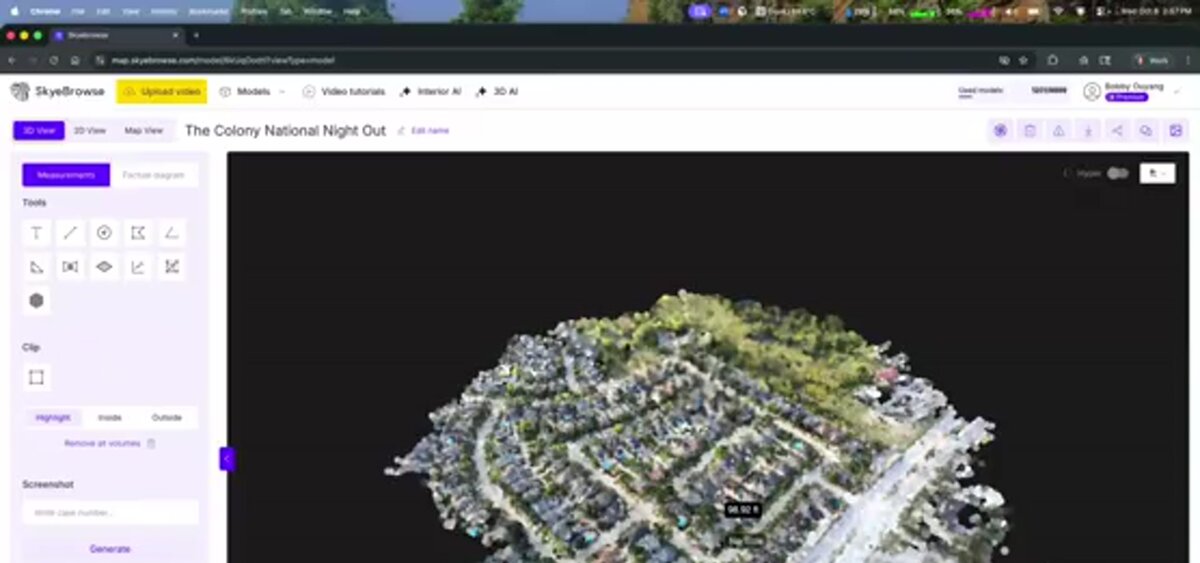
A 3D model places every defect on the actual blade and tower geometry, lets reviewers measure damage size and position from a browser, and preserves the full inspection for year-over-year comparison. Image walkthroughs link each spot on the model to the original video frames, so engineers zoom into full detail without a site visit.
SkyeBrowse uses videogrammetry, which reconstructs 3D geometry from the frames of a continuous video. Upload the inspection video and the cloud returns a 3D mesh, point cloud and orthomosaic, at roughly a minute of processing per minute of video. Commercial and Pro models process at 8K with 0.5 inch accuracy; Public Safety & Enterprise models process at 16K with 0.1 inch accuracy and AI Moving Object Removal. Accuracy improves as the drone flies closer to the surface, so close blade passes produce the most detailed models.
How teams use the model:
- Measure damage. Use the distance tool to size erosion patches and cracks and record their distance from the blade root.
- Annotate findings. Pin notes and severity grades to each defect so the repair contractor sees exactly where to work.
- Review the source frames. Image walkthroughs show the captured frames along the flight path; click one to inspect the blade surface at full detail.
- Compare years. Keep models from each campaign to see whether a crack grew or an erosion patch spread.
- Share and export. Send a link to OEM engineers, insurers or repair crews, and export LAZ, GLB or GeoTIFF for analysis or asset management tools on Pro and Public Safety & Enterprise.
The same workflow covers other energy assets. Our guides to solar farm inspection and utility infrastructure inspections apply it to arrays, substations and lines, and the drone inspection hub covers every asset type.
FAQ
How long does a wind turbine drone inspection take?
An external blade and tower capture usually takes under an hour per turbine, including stopping and positioning the rotor. Rope access inspections keep the turbine offline for hours. With SkyeBrowse, the video processes at roughly a minute per minute of footage, so the 3D model is often ready before the crew reaches the next turbine.
Do wind turbines have to stop for a drone inspection?
Yes, for blade inspections. The turbine is stopped, locked and yawed so the blades sit in a known position, often with one blade pointing straight down. The stop is short compared with rope access, which keeps lost generation low. Surveys of the pad, access roads and site that stay well clear of the rotor do not need a stop.
How much does a wind turbine drone inspection cost?
Service providers price per turbine, and published estimates put drone inspections at a fraction of manual rope access cost. Owners that fly in-house pay for the drone, pilot time and software; SkyeBrowse processing starts at $24.99 per Commercial model, $49.99 per Pro model with exports, and $199 per Public Safety & Enterprise model.
What is the best drone for wind turbine inspection?
The best wind turbine inspection drone combines a high-resolution zoom or full-frame camera, strong wind resistance, obstacle sensing, and at least 35 minutes of flight time. Enterprise platforms such as the DJI Matrice series are common for external blades, and caged drones are used for internal blade and nacelle inspections.
How often should wind turbines be inspected?
Many operators inspect blades at least once a year, with extra inspections before warranty expiry, after lightning strikes, and after severe storms. Fleets with known leading edge erosion often inspect high-risk turbines more often to time repairs before damage reaches the laminate.
Upload your first video free. Create a free SkyeBrowse account, upload a drone video, and get a 3D model processed in the cloud. Freemium organizations that have never had a paid plan can get their first full Commercial model for $5 (normally $24.99), with every Pro tool and export and 90-day storage.